March 2026 | Dear March—Come In
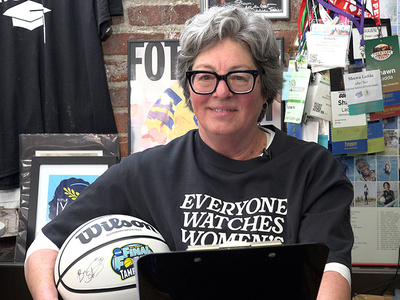
This month’s Classic Reading welcomes the arrival of spring through one of Emily Dickinson’s most imaginative and inviting poems. Join Dr. Shawn Ladda as she reads Dear March—Come In, a playful and reflective work that personifies the month as a long-awaited guest.
Just as March signals a season of energy, anticipation, and renewal on campus and across the landscape, Dickinson’s poem captures the spirit of greeting something both familiar and transformative. In this featured reading, Dr. Ladda’s interpretation brings warmth and clarity to Dickinson’s distinctive voice, inviting both new listeners and longtime readers to experience the poem’s charm and quiet depth.
As April ushers in a season of growth, reflection, and new beginnings on campus and beyond, Hughes’s poem invites us to slow down and listen to the natural world with fresh attention. In this featured reading, Dr. Groarke’s interpretation highlights the musicality and imagery of the poem, offering a moment of calm and appreciation for the simple, restorative power of rain.
Watch Dear March—Come In on YouTube
About This Reading
Emily Dickinson’s Dear March—Come In is a lyrical conversation between the speaker and the month of March, imagined as a long-awaited visitor returning after winter. Through this personification, Dickinson captures the subtle transition between seasons, where anticipation meets uncertainty, and renewal arrives gradually rather than all at once. The poem’s tone shifts between playful and contemplative, reflecting the unpredictable nature of early spring.
In this reading, Dr. Shawn Ladda highlights Dickinson’s distinctive voice and structure, drawing attention to the poem’s rhythm, imagery, and conversational style. The result is an accessible and engaging interpretation that invites listeners to consider how we welcome change, whether in nature, in our routines, or in the rhythms of a new season.
Filming support provided by Michael Grabowski, Ph.D., Director of the Game Design & Production major and Professor in the Communication, Sound, and Media Arts Department, with assistance from Sam Wofford '26.