---
title: "Computational Neuroscience B.S."
url: "/academics/programs/computational-neuroscience-bs"
type: program
date: 2026-09-24
updated: 2026-09-24
---
# Computational Neuroscience B.S.
# Computational Neuroscience B.S.
**Understand the brain through experiment, theory, and computation.**
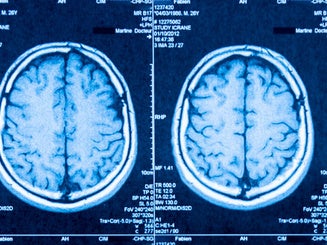
The brain is the most complex system science has ever tried to explain, and today the tools for explaining it are as likely to be a dataset and a model as a microscope. Manhattan University's Bachelor of Science in Computational Neuroscience brings together biology, psychology, mathematics, and computer science in one major, so you learn how neural circuits give rise to perception, thought, and behavior, and how to test those ideas with experiments, data analysis, and computational models. You'll graduate ready for graduate study in neuroscience or for careers in neurotechnology, artificial intelligence, data science, and health.
[ Visit Manhattan University ](/admissions/visit)
[ Request Information ](/admissions/undergraduate/request-information) [ Apply to Manhattan University ](/admissions/undergraduate/apply)
Credit Hours123
Time to Complete4 Years
Image
This program is part of [Interdisciplinary Studies](/academics/kakos)
What Set's Us Apart The Manhattan University Difference
## What Sets Us Apart
Neuroscience used to be a lab science with a bit of statistics attached. Now the field's biggest questions, such as how circuits produce perception, how the brain learns, and what changes in disease, get answered by people who can run the experiment and write the model that explains it. Manhattan University's Computational Neuroscience major was built for that kind of scientist by faculty from five departments. You'll be grounded in biology and psychology while learning the mathematics, programming, and machine learning that modern brain science runs on, and you'll graduate with a senior research project that shows you can do both.
$120,230 Median Salary
Data scientists earn a median salary of $120,230, with 35% projected job growth through 2035, much faster than average, and about 24,800 openings each year across health, technology, and research (U.S. Bureau of Labor Statistics).
Five Departments, One Major
Biology, psychology, mathematics, computer science, and electrical engineering faculty built this major together, so you study the brain from every angle it demands: cells and circuits, cognition and behavior, and the models that connect them.
Experiment Meets Model
You'll run experiments in the lab and build models at the keyboard, then learn how each checks the other: data shapes the model, and the model tells you what to measure next time in the lab.
Machine Learning, Built In
Every student takes Machine Learning and Computational Methods in Neuroscience, so you graduate able to build and evaluate the models reshaping both brain science and the artificial intelligence industry, not just read about them.
A Real Science Foundation
Three semesters of calculus, two each of biology and physics, plus genetics, chemistry, statistics, and programming, give you the serious grounding that graduate programs, research labs, and employers expect from a neuroscience major.
Ethics of the Mind
Neurotechnology raises questions few other fields do, about privacy, agency, mental health, and what makes us who we are. A required ethics course and your capstone explore these issues, staying true to our Lasallian mission.
Why Study Computational Neuroscience Image
The Manhattan Advantage
## Why Study Computational Neuroscience at Manhattan University
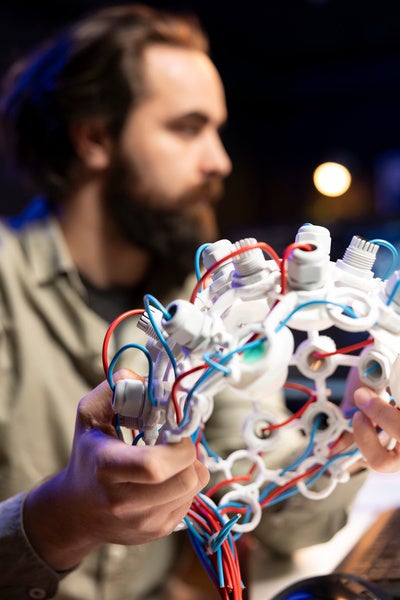
The major starts from one idea: you can't really explain the brain unless you can both observe it and model it. So you'll build the foundation a working neuroscientist needs: two semesters each of biology and physics, three of calculus, plus genetics, chemistry, statistics, and two semesters of programming, and then move into the neuroscience core: behavioral neuroscience, cognitive science, neurobiology, and systems neuroscience. Along the way, you'll learn how the two halves of the field depend on each other, how an experimental result motivates a model, and how that model points to the next experiment.
You'll also learn the computational side properly, not as an add-on. Machine Learning and Computational Methods in Neuroscience teach you to analyze neural and behavioral data, simulate brain systems, and weigh competing explanations of how they work. A cross-disciplinary elective lets you go deeper wherever your interest points: sensation and perception, animal physiology or behavior, molecular cell biology, mathematical modeling, neural networks and deep learning, or, with a bridge course, bioinstrumentation and bio-inspired robotic vision in the School of Engineering. And because this is a liberal arts university, a required ethics course and the Kakos School core curriculum give you room to ask what neurotechnology and data-driven models of the mind mean for privacy, agency, mental health, and identity.
Senior year, you bring it all together in a seminar and capstone project where you frame a question about the brain, gather or analyze real data, build a model, and defend your conclusions the way a graduate student or research scientist would. Graduates are prepared for graduate study in neuroscience, cognitive science, psychology, or biomedical fields, and for careers in neurotechnology, artificial intelligence, data science, and health professions informed by brain and behavioral science.
Image
Curriculum & Courses
Image

## Why Study in New York City
Few cities do brain science at New York's scale. The Simons Foundation's Flatiron Institute runs a Center for Computational Neuroscience in Manhattan, Columbia's Zuckerman Institute, NYU's Center for Neural Science, and Rockefeller University anchor some of the most productive neuroscience research anywhere, and Mount Sinai, NYU Langone, and NewYork-Presbyterian treat the disorders that research is trying to explain. In the Bronx, the Albert Einstein College of Medicine and Montefiore are a few miles from campus. On the industry side, Google and Meta run AI research labs in the city, and IBM Research is up the road in Westchester. For students in the major, that means research internships, lab placements, and first jobs are close by, at the places whose papers you'll read in class.
Image

## Computational Neuroscience: From Synapse to Simulation
A computational neuroscience education at Manhattan University builds skill at every level the brain can be studied, from the biology of a single neuron to a model that predicts behavior. Every course strengthens one of six core competencies, developed through lab work, problem sets, coding projects, and the senior capstone rather than lecture alone. Together they produce graduates who can ask a question about the brain and answer it with an experiment, a dataset, and a model.
Neural Systems
Learn how the brain is built and how it works, from ion channels and synapses to the circuits and systems behind sensation, movement, and memory, through coursework in neurobiology, systems neuroscience, and genetics.
Cognition and Behavior
Connect what neurons do to what people and animals do. Behavioral neuroscience and cognitive science show how neural activity gives rise to perception, learning, decision-making, and behavior, and how each can be measured.
Experimental Methods
Good models start with good data. Learn to design experiments, control for what could mislead you, and collect neural and behavioral measurements in the lab that a model can be tested against.
Data Analysis
Neural data is noisy, high-dimensional, and full of traps. Applied statistics and two semesters of programming teach you to clean and analyze data and to show what the data does and doesn't show.
Computational Modeling and Machine Learning
Turn ideas about the brain into models you can run. Build simulations of neural systems, fit them to real data, and apply machine learning to find structure that no one could spot by eye.
Research and Scientific Communication
Science isn't finished until you can explain it confidently. In the senior seminar and capstone project, frame your question, carry it through data and modeling, and present your findings the way researchers do, in writing and in person.
Explore Faculty ## **Learn From Faculty Across Five Departments**
Computational Neuroscience students learn from faculty in five departments: Biological and Chemical Sciences, Social and Behavioral Sciences, Mathematics and Physics, and Computer Science in the Kakos School of Arts and Sciences, and Electrical and Computer Engineering in the School of Engineering. Biologists and psychologists teach the neuroscience core and run the labs, mathematicians and computer scientists teach the statistics, modeling, and machine learning, and engineering faculty open the door to bioinstrumentation and robotic vision. All of them teach in small classes, and faculty from the participating departments guide the senior seminar and capstone project from first question to final presentation.
[Meet the Biological and Chemical Sciences Faculty](/academics/kakos/departments/bio-chem/faculty) [Meet the Social and Behavioral Sciences Faculty](/academics/kakos/departments/social-behavioral/faculty)
[Meet the Mathematics and Physics Faculty](/academics/kakos/departments/math-physics/faculty) [Meet the Computer Science Faculty](/academics/kakos/departments/computer-science/faculty)
[Meet the Electrical and Computer Engineering Faculty](/academics/engineering/departments/electrical-computer/faculty)
Careers & Outcomes
Image
About
## Kakos School of Arts and Sciences
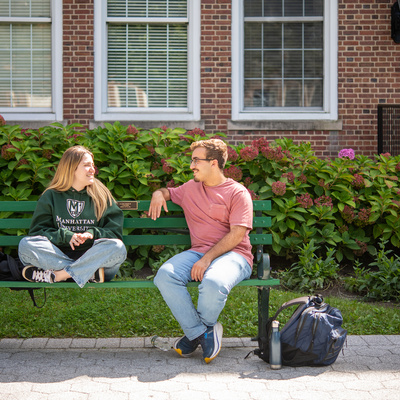
The B.S. in Computational Neuroscience makes its home in the Department of Interdisciplinary Studies within the Kakos School of Arts and Sciences, with elective coursework from the School of Engineering. The Kakos School is the largest of Manhattan University's three schools, offering 33 undergraduate majors, six graduate programs, and six combined degrees across the humanities, natural and social sciences, and professional fields. Grounded in the University's Lasallian Catholic mission and located near the heart of New York City, the School pairs rigorous academics with small classes, close faculty mentorship, and real-world experience throughout the five boroughs and beyond. That foundation delivers: Manhattan University ranks in the top 3% nationally for salary impact (*Wall Street Journal*, 2026), a measure of how strongly a degree here translates into graduates' career earnings.
[ Explore Kakos School of Arts and Sciences ](/academics/kakos) [ Explore the O'Malley School of Business ](/academics/business)
Image
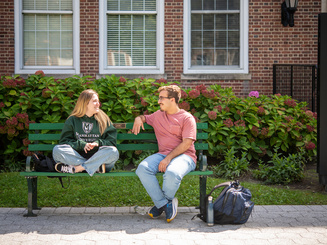
Program Costs & Financial Aid ## Program Costs & Financial Aid
Manhattan University is committed to making a high-quality, career-focused education accessible and affordable. Through a combination of competitive tuition, robust financial aid, and our **Jasper Guarantee**, students and families can plan their education with confidence. The Jasper Guarantee locks your tuition rate for all four years—ensuring financial stability and eliminating unexpected increases as you work toward your degree.
More than 90% of Manhattan University students receive some form of financial assistance, including merit scholarships, grants, and need-based aid, significantly reducing the overall cost of attendance.
- **Tuition & Fees:** View current undergraduate rates
- **Financial Aid:** 90%+ of students receive aid
- **Scholarships:** Multiple merit- and need-based opportunities
- **Jasper Guarantee:** Your tuition rate is locked for all four years
A Manhattan University education is an investment in your future, and we are dedicated to helping you access the resources that make it possible.
[Learn More About Costs and Financial Aid](/admissions/financial-aid/)
Image
A Smarter Investment in Your Future
## Jasper Guarantee
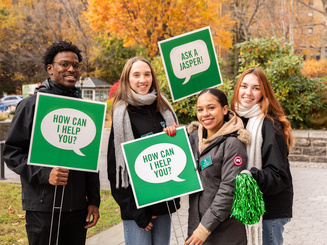
At Manhattan University, every undergraduate student is protected by the Jasper Guarantee, which locks your tuition rate for all four years—ensuring clarity, stability, and peace of mind as you plan your education. This promise reflects our commitment to affordability and to supporting students and families throughout their academic journey.
[ Learn More About the Jasper Guarantee ](/admissions/undergraduate/jasper-guarantee)
Image

Admission Information ## Admissions Information for Manhattan University
**Start Your Journey in Computational Neuroscience**
Applying to Manhattan University is designed to be clear and accessible. Review the requirements below to take the next step toward your degree.
**Requirements:**
- Application & transcript
- SAT/ACT optional
- Personal statement
- Letter(s) of recommendation
**Deadlines:**
- Early Action: November 15
- Regular Decision: February 1
[Admission and Application Process](/admissions/financial-aid/)
### International Students:
Support available for visas, documentation, and English-language assessments.
[Learn More about International Financial Aid](/admissions/international/financial-aid/)
Image

## Prepare for the Real World
At Manhattan University, your education is built around who you are and where you want to go. Whether you’re ready to apply or just starting to explore, take the next step when you’re ready — we’re here to help.
[Visit Manhattan University](/admissions/visit)
[Apply Today](/admissions/apply)
[Request Information](/admissions/request-information)
Image

## Related Programs
Image

[Biology B.A. B.S. / Minor](/academics/programs/biology)
Image
[Psychology B.A / B.S. / Minor](/academics/programs/psychology)
Image

[Data Science B.S.](/academics/programs/data-science)